


COLLEGE AGE MUSICIANS

ARE YOUR EARS AT RISK?
Yes!
College musicians are at a higher risk of noise-induced hearing loss (NIHL) than their non-musician peers. Research has shown that 45% of surveyed student musicians have a noise-induced hearing loss and students who reported practicing more than two hours per day had a more significant noise-notch, meaning the volume of sound must be louder for the student to detect it (Phillips et al., 2010).
Additionally, musicians reported other complaints, such as a high prevalence of tinnitus and sensitivity to loud sounds, also known as, hyperacusis (Jansen et al., 2009).

WHO IS THE LOUDEST?
It depends!
When you are sitting in band practice, look at the instruments that are around you and then look at this table. This table shows the average volume of the instruments that you or your friends could be playing.
Who is the loudest and closest to you?
If you are playing the saxophone loudly, your ears can only handle the volume for 56 seconds before your ears are at risk for damage to occur.
By wearing hearing protection, your ears can handle that volume much easier and for longer periods of time.
This is why it is so important for you to wear hearing protection to help protect your ears.
Adapted from:
Chasin, M. (2006). Sound levels for musical instruments. Hear Review, 13 (3), p.34-41.
OSHA Permissible Exposure Limit
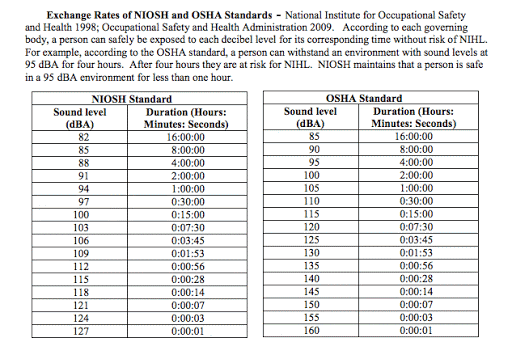
HOW LOUD IS TOO LOUD?
This table shows the volumes of sound (dBA) and the period of time that you can listen to that volume of sound before damage occurs to your ears.
For our purposes, look at the table on the right.
Here is an example:
If you are playing in band and the music you are reading says fortissimo, you are likely playing at a very high volume. If that volume were to reach 135dBA, your ears can only be exposed to that volume for 56 seconds before damage is likely to occur.
Hearing protection helps your ears handle loud volumes for longer periods of time.
WHAT DO OTHER MUSICIANS THINK ABOUT HEARING PROTECTION?
Out of 90 musicians surveyed, the main hesitations for using hearing protection included:
- Improved performance effects (65%)
Improved auditory perception (22%)
Improved communication (6%)
However, following a trial period of wearing non-custom high-fidelity earplugs during rehearsal and a 30-minute lecture about ear protection, the 90 musicians surveyed stated that the:
Top reported advantages of using hearing protection included:
- Hearing preservation or protection from hearing loss (64%)
Reduction in noise exposure (12.5%)
Improved auditory perception (8%)
Longer playing time without breaks (8%)
If these musicians changed their perspective on using hearing protection, then it is encouraged for all musicians to try non-custom protection to see the difference for themselves.
Source: Olson and colleagues (2016)

What does hearing loss sound like?
Check out these videos to see what hearing loss sounds like!
WHAT I WISH I KNEW...
There are many photos of me on stage being surrounding by other musicians. As a young musician, I was not told about the implications of listening to loud sounds over time, just like many other musicians weren't. I am a part of the 79.4% of college-aged musicians who had never been taught about healthy hearing practices (Dinakaran et al., 2018).
Because of my training as a musician and my passion about hearing protection, it is my hope that whoever is reading this will have the opportunity to protect their hearing now and make an informed decision about healthy hearing practices to come.

Citations
Chasin, M. (2006). Sound levels for musical instruments. Hear Review, 13 (3), p.34-41.
Dinakaran, T., Deborah, R.D., & RejoyThadathil, C. (2018). Audiology Research, 8, 9-12.
Jansen, E.J., Helleman, H.W., Dreschler, W.A. & de Laat, J.A.P.M. (2009). Noise-induced hearing loss and other hearing complaints among musicians of symphony orchestras. International Archives of Occupational and Environmental Health, 82, 153-164.
Olson, A.D., Gooding, L.F., Shikoh, F., & Graf, J. (2016). Hearing health in college instrumental musicians and prevention of hearing loss. Medical Problems of Performing Arts, 31 (1). doi:10.21091/mppa.2016.1006
Phillips, S.L., Henrich, V.C. & Mace, S.T. (2010). Prevalence of noise-induced hearing loss in student musicians. International Journal of Audiology, 49, 309-316.